

close
Choose Your Site
Global
Social Media

Views: 0 Author: Site Editor Publish Time: 2026-06-25 Origin: Site


Incorrect valve specification in industrial piping systems leads to severe operational consequences. Engineers frequently face fugitive emissions, catastrophic failure, and unplanned downtime when selecting the wrong isolation valves. You must balance mechanical reliability against system demands. Misapplying a valve causes premature seat wear, cavitation, or system-wide fluid hammer.
Engineers and procurement teams face dilemmas when selecting isolation valves. You need unobstructed flow, reliable shutoff, and predictable actuation. We will evaluate mechanical design, flow characteristics, and application-specific compliance. This guide provides a rigorous technical evaluation of both valve types to help you specify the right component for your piping infrastructure.
Understanding the fundamental mechanics ensures safe and efficient fluid handling. We explore design codes, seating technologies, and actuation speeds. You will learn how to match specific valve features to your operational outcomes, mitigating risks like thermal binding and hydraulic shock.
Operational Speed vs. Safety: Ball valves provide rapid, quarter-turn shutoff but introduce water hammer risks; gate valves require multi-turn actuation, inherently protecting systems from pressure spikes.
Sealing Integrity: Ball valves generally offer superior, bubble-tight sealing for critical gas and chemical applications, whereas gate valves are optimal for high-volume, straight-line liquid flow with minimal pressure drop.
Application Specificity: Large-diameter water infrastructure heavily relies on gate valves for cost efficiency, while high-pressure petrochemical environments demand specialized trunnion or double block and bleed ball valves.
Cost Dynamics: Gate valves typically offer a lower initial cost, especially in larger diameters, but ball valves often present a lower TCO in high-cycle applications due to reduced maintenance requirements.
Defining the success criteria for isolation valves requires understanding unobstructed flow, reliable shutoff, and predictable actuation. You must evaluate the internal mechanics to ensure system compatibility across various pressure classes and media types.
A gate valve utilizes a linear motion mechanism to isolate fluid. The stem connects the handwheel to the disc, moving it up and down. Rising stem designs provide visual indication of the valve position. Non-rising stem designs save vertical space in tight installations, keeping the threaded portion inside the valve body.
Wedge types dictate how the valve responds to thermal expansion and pipeline stress. Solid wedges offer simplicity and strength for general applications. Flexible wedges feature a perimeter cut, allowing them to adapt to seat angle changes caused by pipe deflection. Split wedges consist of two separate pieces, providing self-alignment and preventing binding in high-temperature services.
Primary design codes govern manufacturing standards. API 600 covers heavy-duty bolted bonnet steel valves for refinery use. API 602 specifies compact forged steel valves for smaller pipelines. API 603 addresses corrosion-resistant alloy valves for chemical processing. These standards ensure structural integrity under pressure.
Standard trim configurations define the metallurgical properties of internal components. API Trim 5 uses hard-faced seats for abrasion resistance. Trim 8 combines 13% Cr steel with hard-facing for general oil and gas service. Trim 12 utilizes 316 stainless steel for enhanced corrosion resistance. When fully open, the disc retracts completely into the bonnet. This creates a near-zero pressure drop across the valve.
Wedge Type | Primary Advantage | Best Application Environment |
|---|---|---|
Solid Wedge | High structural strength | Standard ambient temperature liquids |
Flexible Wedge | Compensates for seat distortion | Pipelines with bending loads |
Split Wedge | Prevents thermal binding | High-temperature steam and gas |
Ball valves operate using a quarter-turn rotational motion mechanism. A perforated sphere pivots 90 degrees to block or allow flow. This design enables rapid actuation and immediate shutoff, making them highly responsive in automated control loops.
Floating ball designs rely on line pressure to push the ball against the downstream seat. This creates a tight seal but limits application in high-pressure systems. Trunnion-mounted designs mechanically anchor the ball at the top and bottom. This stability makes them suitable for high-pressure and large-diameter applications.
Key design codes include API 6D for pipeline valves, API 608 for flanged and threaded valves, and ASME B16.34 for pressure-temperature ratings. These codes dictate wall thickness, material selection, and testing protocols.
Seat technologies determine sealing capabilities and temperature limits. Elastomer and thermoplastic soft seats like PTFE, Devlon, and PEEK provide bubble-tight shutoff in clean services. Metal-to-metal seating utilizes High-Velocity Oxygen-Fuel (HVOF) coatings. These hard-faced seats withstand abrasive particulates and extreme temperatures.
Seat relief design mechanics manage cavity pressure. Single Piston Effect (SPE) seats are self-relieving, venting excess pressure into the pipeline. Double Piston Effect (DPE) seats provide double isolation, sealing from both directions. Bore types impact flow coefficients (Cv) and piggability. Full port valves match the pipe's internal diameter, allowing unrestricted flow. Reduced port valves introduce a slight pressure drop but require less installation space.
Selecting the correct valve requires matching its mechanical features to your specific operational outcomes. You must evaluate flow control, actuation speed, sealing integrity, and maintenance requirements.
A strict industry rule applies to linear isolation valves: they must only be used for fully open or fully closed isolation. Throttling fluid creates high-velocity flow across the partially open disc. This causes wire drawing, where the fluid erodes the metal seating surfaces. Seat erosion compromises the valve's ability to provide a tight shutoff.
Ball valves also face limitations in throttling applications. Standard designs experience uneven seat wear when partially open. However, specialized v-port designs can handle moderate flow control. The v-shaped notch characterizes the flow, providing better precision than standard round bores.
Rapid closing introduces severe risks to liquid pipelines. Quarter-turn actuation can cause water hammer, a destructive hydraulic shock. The sudden halt of fluid momentum generates a pressure spike that damages pipes, supports, and instrumentation.
Multi-turn operation offers a mechanical advantage in mitigating pressure surges. The slow, gradual closing process allows fluid momentum to dissipate safely. This makes linear motion valves preferable in long liquid pipelines where hydraulic shock poses a significant threat.
Soft-seated rotational valves offer superior bubble-tight shutoff for gases and light liquids. They easily meet stringent leakage rates defined in API 598 or ISO 5208. Metal-seated linear valves provide robust sealing but may allow permissible leakage rates under specific test conditions.
Suspended solids impact sealing performance differently. Linear motion allows the wedge to shear through slurries and push particulates out of the seating area. Rotational motion can drag particulates across soft seats, scoring the material and causing permanent leaks. Metal-seated trunnion designs are required when handling abrasive media.
Maintenance profiles differ significantly between the two designs. Linear valves feature a backseat design. This allows operators to replace stem packing while the system remains under pressure. You fully open the valve, engaging the stem against the bonnet to seal off the packing chamber.
Rotational valves offer different maintenance access based on body construction. Top-entry designs permit inline seat and seal replacement without removing the valve from the piping. Split-body or all-welded body designs require complete removal from the line for internal repairs. Welded bodies eliminate leak paths but sacrifice inline repairability.
Isolate the pipeline section and depressurize the line completely.
Remove the bonnet bolts and carefully lift the top-entry cover.
Extract the ball and seat rings using specialized lifting tools.
Inspect the body cavity for scoring or debris accumulation.
Install new seats and seals, ensuring proper alignment before reassembly.
Different industries impose unique regulatory and operational demands. You must specify valves that comply with sector-specific standards and handle the intended media safely.
Selecting gate valves for water treatment requires evaluating the media and pipeline diameter. These valves efficiently handle sludge and raw water without clogging. They provide unobstructed flow paths for large-diameter distribution networks.
Resilient wedge designs comply with AWWA C509/C515 standards. An elastomer-coated wedge compresses against a smooth valve body, ensuring a tight seal even with minor debris. Metal-seated designs are preferred for wastewater bypass applications where abrasive grit would quickly degrade rubber coatings.
Refining and gas transmission lines require strict API 6D and API 608 compliance. A petrochemical control ball valve must withstand high pressures and aggressive media. Engineers specify robust trunnion designs to ensure reliable isolation in critical process units.
Fugitive emission standards like ISO 15848-1 and API 622/624/641 dictate stem packing configurations. Volatile organic compounds pose environmental and safety risks. Design engineers choose live-loaded graphite packing or specialized chevron rings to maintain tight stem seals under thermal cycling.
Secondary safety requirements include fire-safe testing and anti-static designs. API 607 and API 6FA certifications ensure the valve maintains acceptable leakage rates during a fire. Anti-static devices ground the ball to the body, preventing static electricity buildup that could ignite flammable media.
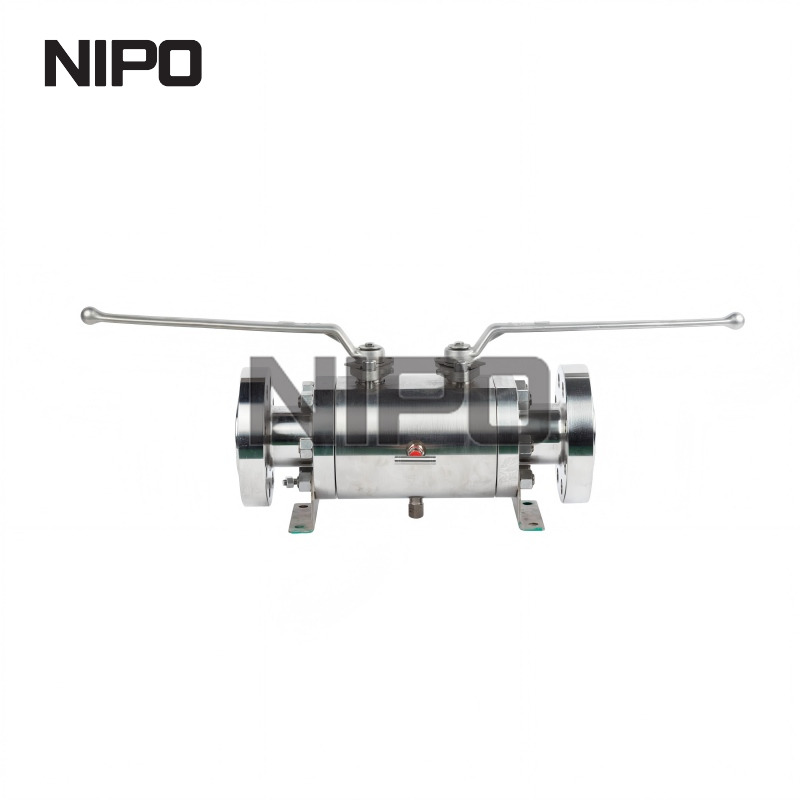
Hazardous hydrocarbons and high-pressure chemical lines require verifiable isolation. A double block and bleed (DBB) ball valve provides this safety architecture. It features two inline seating surfaces with a bleed cavity between them.
A standard DBB configuration seals against pressure from both ends, allowing the cavity to be vented. A Double Isolation and Bleed (DIB-1 and DIB-2) configuration provides enhanced safety. DIB designs utilize bi-directional seats to provide double isolation from a single pressure source.
These configurations provide verifiable isolation for maintenance. You can bleed the cavity to confirm the upstream seat is holding. This eliminates the need for multiple separate valve installations, reducing the overall footprint and minimizing potential leak paths.
Selecting reliable equipment requires rigorous vetting of suppliers and comprehensive quality control protocols. You must verify manufacturing capabilities and material traceability.
Evaluating a reputable gate valve manufacturer involves auditing their foundry sources and machining facilities. You need suppliers with proven track records in your specific industry. Verify their ISO 9001 certification and adherence to relevant API standards.
Stringent QA/QC protocols ensure mechanical integrity. Non-Destructive Testing (NDT) capabilities are essential. Radiographic Testing detects internal casting flaws. Ultrasonic Testing measures wall thickness and identifies subsurface defects. Dye Penetrant Testing reveals surface cracks on machined components.
Hydrostatic and pneumatic pressure testing confirm pressure-retaining capabilities. API 598 dictates the test pressures and duration. The shell test verifies body integrity, while the seat test confirms sealing performance under pressure.
You must request comprehensive documentation for all pressure-retaining parts. Material Test Reports verify the chemical composition and mechanical properties of the metals used. Positive Material Identification certificates confirm the correct alloys were utilized during assembly.
EN 10204 3.1 certification provides traceable proof of material compliance. Evaluating the supply chain scalability ensures you have access to aftermarket support. Reliable manufacturers maintain inventory for critical replacement parts like seats, seals, and stems.
Installation and operation introduce specific risks that must be managed during the design phase. You need to account for space, automation, and thermal dynamics.
Physical dimensions dictate valve selection in tight piping galleries. Rising-stem designs require significant vertical clearance above the pipe to accommodate the upward movement of the stem. You must ensure adequate space for operation and maintenance.
Manual rotational valves require horizontal lever clearance. The handle swings 90 degrees, which can interfere with adjacent pipes or walkways. Gear operators or compact actuators mitigate horizontal space constraints but add weight to the assembly.
Automating valves requires precise torque and thrust calculations. Rotational valves demand high breakaway torque to unseat the ball, especially after long periods of inactivity. Running torque is lower, but safety margins must account for media viscosity and seat friction.
Linear valves require linear thrust to pull the wedge out of the seats. Actuator sizing must overcome the differential pressure across the disc and the friction of the stem packing. Oversized actuators can damage the stem, while undersized units fail to operate under maximum differential pressure.
Thermal expansion creates severe operational risks. Linear valves can become locked in the closed position if the body cools and contracts around the wedge. Trapped cavity pressure can also force the wedge tightly into the seats, preventing operation.
Mitigation tactics include drilling cavity relief holes in the upstream side of the wedge. External bypass loops equalize pressure before opening. Using flexible or split wedges instead of solid wedges allows the internal components to absorb thermal expansion without binding.
Rotational valves face similar pressure-trapping risks in the body cavity. Liquid trapped between the seats expands rapidly when heated. You must mitigate this using self-relieving seats or external bleed valves to vent excess cavity pressure safely.
The choice between these two isolation mechanisms depends entirely on your system's fluid, pressure, and operational cycle. Mechanical design must align with process realities to ensure safety and reliability. Review the decision matrix below to guide your specification process.
Application Criteria | Gate Valve Recommendation | Ball Valve Recommendation |
|---|---|---|
Operation Frequency | Infrequent operation (isolation only) | High-cycle operations |
Media Type | Slurries, raw water, heavy liquids | Clean gases, volatile chemicals |
Actuation Speed | Slow, multi-turn (prevents water hammer) | Fast, quarter-turn response |
Safety Architecture | Standard straight-line isolation | Critical DBB setups required |
Take the following actions to finalize your valve specifications:
Audit your current Piping and Instrumentation Diagrams to identify all critical isolation points.
Calculate the required flow coefficients and acceptable pressure drops for each specific line.
Evaluate the physical installation space to ensure adequate clearance for stems or actuation levers.
Consult with a certified valve engineer to verify material compatibility and regulatory compliance.
A: No. Throttling creates high-velocity flow across the partially open disc. This causes severe vibration and wire drawing, which erodes the metal seating surfaces. Seat erosion permanently compromises the valve's ability to provide a tight shutoff.
A: Large diameters require immense machining precision to maintain the spherical tolerance of the ball. The material volume increases significantly, and complex trunnion seating mechanisms are required to handle the massive differential pressures without deforming the internal components.
A: Trunnion-mounted designs excel in high-pressure gas and chemical systems due to their mechanically anchored ball and reliable soft seats. High-pressure steam and heavy oil applications often utilize heavy-duty API 600 linear valves with hard-faced metal seats.
A: You prevent thermal binding by specifying flexible or split wedges that absorb thermal expansion. Drilling a cavity relief hole on the upstream side of the wedge prevents pressure locking caused by trapped, expanding fluids.
A: A Double Block and Bleed configuration provides verifiable double isolation within a single valve body. It allows operators to bleed the center cavity, proving the upstream seat is holding pressure before performing downstream maintenance.
A: Yes. Rising stem designs provide immediate visual confirmation of the valve's position. The threaded portion of the stem is also located outside the fluid stream, protecting it from corrosive media and allowing for easy lubrication.


