

close
Choose Your Site
Global
Social Media

Views: 0 Author: Site Editor Publish Time: 2026-06-04 Origin: Site


Upgrading water plant infrastructure requires balancing capital expenditure alongside long-term reliability. Unmitigated water hammer and inefficient flow paths quietly erode plant profitability. Traditional swing check valves often introduce high impact wear. Engineers call this phenomenon valve slam. These older designs also demand heavy structural support. Evaluating a double disc check valve requires looking past the initial price tag. You must understand its impact on long-term performance, spatial footprint, and pump protection. Today’s retrofits prioritize preventative maintenance. A modern valve needs to do more than just block reverse flow. It must actively protect high-value pumps from destructive forces. You will learn exactly how dual-plate designs alter closing dynamics. We will explore their specific advantages, honest limitations, and critical sizing practices for modern water systems.
Compact & Lightweight: Reduces weight by up to 80–90% compared to traditional flanged single-plate valves, minimizing pipe stress.
Non-Slam Dynamics: Spring-loaded plates close before reverse flow occurs, preventing destructive water hammer and protecting high-value pump assets.
Application Specificity: Highly effective for treated effluent and clean water systems, but structurally inappropriate for heavy raw wastewater or high-solids slurries.
Sizing is Critical: Oversizing leads to plate chattering and premature failure; exact flow velocity matching is required for reliable operation.
Modern water plants face tremendous operational pressures. They must maintain continuous flow while protecting expensive assets. Traditional mechanical valves often introduce hidden operational penalties. Pipe-shaking valve slam ranks among the worst offenders. It systematically destroys pipe flanges. It bends swing arms. Eventually, it compromises highly sensitive pump rotors.
Procurement and engineering teams demand better solutions today. You cannot simply buy the cheapest mechanical valve available. Successful upgrades must prioritize preventative maintenance. Engineers must also focus on pressure drop reduction. Spatial efficiency matters greatly in tight retrofit environments. A bulky valve requires costly pipe modifications. It also demands heavy steel support structures.
The double disc check valve offers a fundamental shift in closing dynamics. Traditional valves use heavy single plates. Gravity slowly pulls them down. This sluggish response allows reverse flow to build momentum. The reverse flow then slams the plate against the seat. Dual-plate designs solve this issue beautifully. They utilize a center-hinged design. Torsion springs actively push the plates closed. This spring-assisted action happens before fluid reverses. It addresses systemic wear-and-tear directly at the source.
Space constraints plague nearly every municipal water facility retrofit. Older pumping stations rarely have room for bulky flanged valves. Dual-plate valves solve this spatial challenge instantly.
Compact Nodes: Face-to-face dimensions perfectly align with short-pattern standards like API 594. You can slip them between standard flanges easily.
Weight Reduction: A typical dual-plate unit weighs 80–90% less than conventional flanged check valves. Two technicians can often install smaller sizes manually.
Cost Savings: This lightweight profile lowers installation costs significantly. It eliminates the need for expensive structural pipe supports. It fits effortlessly into space-constrained projects.
Water hammer destroys pipelines over time. It causes catastrophic joint failures. It triggers expensive emergency shutdowns. Preventing it remains a top priority for water engineers.
Spring-Loaded Action: Strong torsion springs force the plates to close rapidly. They shut firmly prior to any fluid reversal.
Asset Protection: This rapid response completely eliminates violent mechanical impacts. It safeguards upstream pumps from shockwaves. You extend the operational life of your entire pipeline network.
Pumping water requires massive electrical consumption. Any restriction in the pipeline forces pumps to work harder. Inefficient valves drain municipal budgets steadily over decades.
Streamlined Flow: The internal flow paths minimize fluid turbulence. When plates open fully, water glides past them smoothly.
Energy Savings: Lower head loss translates directly into reduced electrical draw. Pumps use less power over a 20-to-30-year plant lifecycle. This creates immense energy efficiency for the facility.
Many modern facilities handle treated water mixed with aggressive chemical additives. These chemicals pose severe environmental and safety hazards. Leaks are completely unacceptable.
Pinless Engineering: Retainerless designs completely remove external body penetrations. The hinge pins stay fully secured inside the valve body.
Zero Leak Paths: This construction eliminates potential fugitive leak paths entirely. It provides crucial safety guarantees for toxic or corrosive fluid handling.
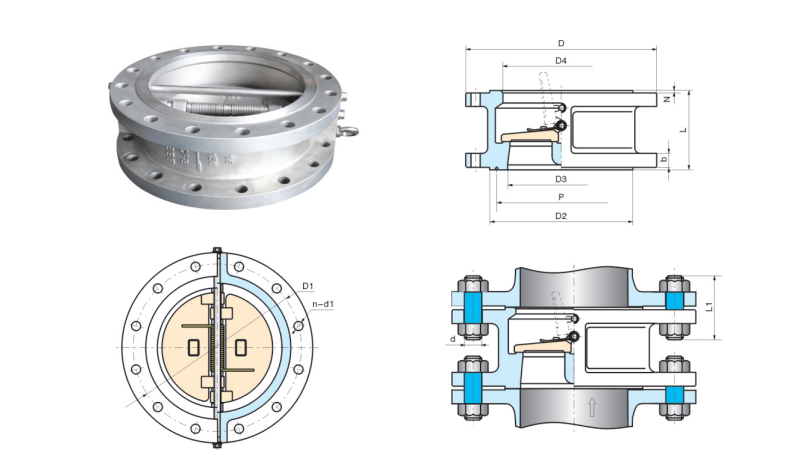
No valve solves every engineering problem. Applying the wrong valve to a system guarantees failure. You must understand specific operational boundaries. E-E-A-T principles demand transparent discussions about equipment limitations. We must highlight where these valves struggle.
Raw Wastewater and Slurry Risks: You should never install these valves in raw sewage lines. The central hinge pin protrudes directly into the flow path. Torsion springs also sit in the fluid stream. High-solids sewage contains rags, plastics, and debris. This debris will inevitably snag on the internal hardware. The buildup leads to a stuck-open state. You lose all reverse flow protection. For heavy slurries, we strongly recommend duckbill valves or specialized slurry check valves.
The Danger of "Oversizing": Many engineers mistakenly match valve size to pipe diameter blindly. They ignore actual flow rates completely. This remains a fatal flaw in valve specification. Insufficient fluid velocity prevents the plates from fully opening. The plates hover in the flow stream. They bounce rapidly against the fluid. Engineers call this severe "chattering." Chattering causes accelerated hinge wear. It leads to premature spring failure. You must match the valve to the exact flow velocity.
Pulsating Flow Environments: Reciprocating compressors create aggressive pulsating flows. They send shockwaves down the pipeline constantly. Standard dual-plate valves struggle here. The plates flutter violently under pulsating conditions. They are not ideal immediately downstream of these compressors. You must request custom-engineered, heavy-duty springs to prevent dynamic instability in these specific zones.
Selecting the ideal check valve requires careful comparisons. Water plant operators frequently choose between three dominant valve styles. Each type offers distinct behavioral traits under pressure. Let us examine how a double disc check valve measures up against its primary alternatives.
Feature | Double Disc Check Valve | Traditional Swing Check | Axial / Nozzle Check |
|---|---|---|---|
Closing Dynamics | Spring-assisted, non-slam operation. | Gravity-dependent, prone to severe slamming. | Top-tier non-slam performance. |
Installation Space | Extremely compact (short face-to-face). | Requires large clearances for the swing arc. | Often bulky and requires substantial space. |
Orientation Versatility | High. Can be installed horizontally or vertically (flow-up). | Low. Generally restricted to horizontal piping. | High. Adaptable to multiple orientations. |
Capital Investment | Moderate. High ROI for standard municipal use. | Low. Cheapest initial purchase price. | Very High. Used strictly for critical high-pressure lines. |
Vs. Traditional Swing Check: The dual-plate model eliminates heavy gravity reliance entirely. It allows for highly versatile installation orientations. You can safely install them in vertical flow-up configurations. Most importantly, it completely mitigates the severe slam inherent to swing types.
Vs. Single Plate Check: Large diameter municipal pipes experience intense fluid forces. Single plate valves struggle to distribute these loads. Two smaller plates distribute the load evenly. They offer much faster response times. They provide vastly superior dynamic stability during turbulent events.
Vs. Axial / Nozzle Check: Axial valves offer the absolute highest tier of non-slam performance. However, they carry an exorbitant price tag. Dual-plate units provide comparable water hammer mitigation. They achieve this at a mere fraction of the capital cost. This provides a superior return on investment for standard municipal water applications.
Proper installation guarantees decades of reliable service. Poor installation guarantees endless maintenance headaches. Engineering teams must follow strict implementation protocols. Adhering to recognized industry frameworks ensures optimal safety and performance.
Precision Sizing: Do not guess your valve size. Utilize standardized pressure drop formulas. Engineers rely on the fundamental equation: h = K * v² / 2g. This ensures the valve operates within its optimal fluid velocity range. You must maintain a minimum velocity to hold the plates fully open. If velocity drops too low, chattering destroys the internal springs. Consult manufacturer flow charts meticulously.
Installation Clearances: Fluid turbulence ruins valve internals rapidly. You must install the valve with adequate straight-pipe runs. We recommend keeping 3 to 5 pipe diameters of clearance. Keep them away from immediate pump discharges. Keep them away from sharp elbows or T-junctions. Smooth, laminar flow extends the hardware lifespan significantly.
Material Selection & Compliance: Always ensure strict alignment with API 594 or AWWA standards. Your material choices dictate corrosion resistance. Specify 316SS (CF8M) stainless steel for corrosive chemical environments. Use Aluminum Bronze for marine intake or desalination plants. For standard treated municipal water, specify epoxy-coated Carbon Steel. The epoxy coating prevents rust while keeping costs reasonable.
We also advise inspecting the pipeline thoroughly before bolting the flanges. Weld slag and construction debris often remain inside new pipes. Flush the lines completely. A single piece of weld slag can jam the hinge pin permanently. Preventative site hygiene remains your best defense against premature failure.
Modern water plants cannot afford unpredictable pipeline failures. You need infrastructure built for resilience and efficiency. Double disc check valves represent a high-value, preventative investment. They offer unmatched space savings for cramped pump stations. They deliver critical protection against pipeline-shattering water hammer. By abandoning outdated gravity-swing designs, plants secure reliable, long-term operational stability.
Before moving to procurement, your engineering teams must take specific action steps. First, conduct a precise flow analysis to avoid fatal oversizing. Second, verify your exact fluid composition. Remember to avoid installing these in raw sewage lines. Finally, consult manufacturer sizing charts to select the perfect spring tension. These targeted steps ensure your new valves perform flawlessly for decades.
A: No. The central hinge and springs can catch rags and solid debris, causing the valve to fail open. They are strictly recommended for clean water, treated effluent, or filtered systems.
A: Chattering occurs when the fluid velocity is too low to keep the plates fully open, often because the valve is oversized for the system's actual flow rate.
A: Yes, their spring-loaded design allows for flexible installation angles, including vertical orientations with upward flow, unlike gravity-dependent swing check valves.


